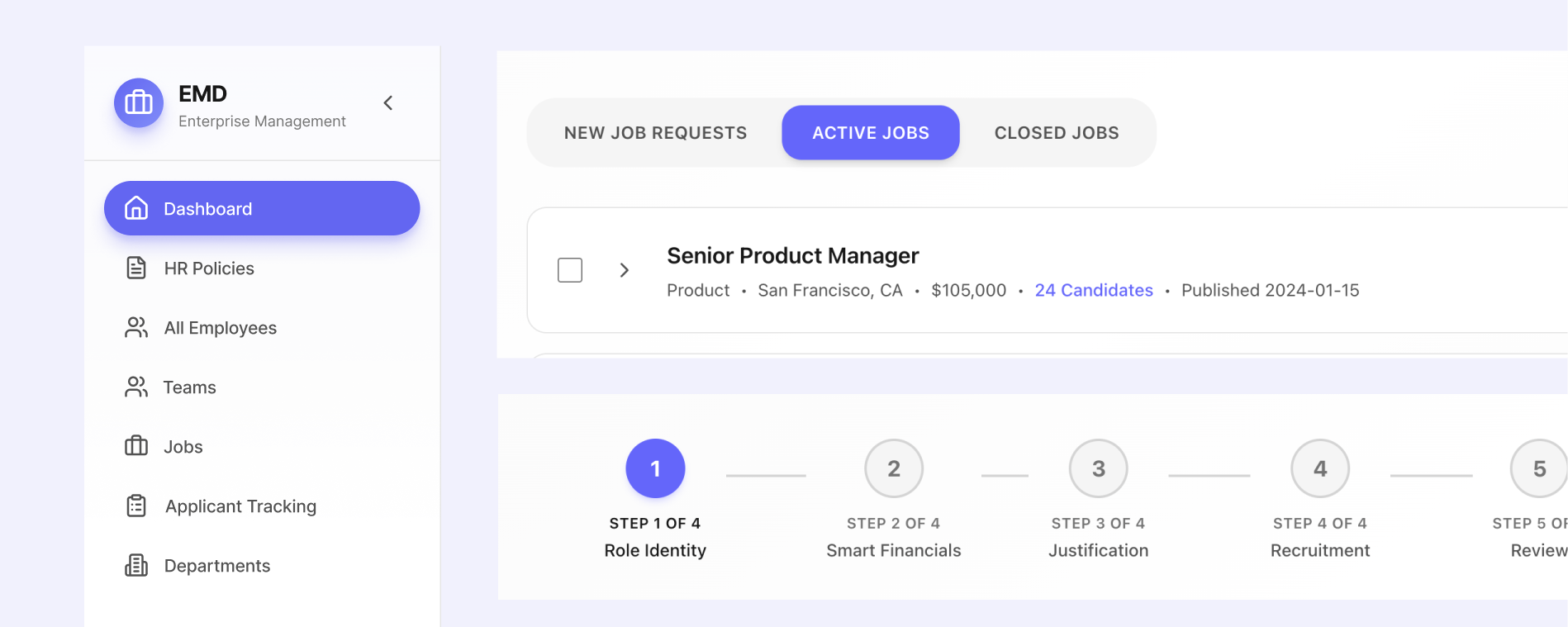
EMD is the internal system used at School of Coding & AI (SOC). I led UX and UI for its role-based workflows, starting with hiring approvals and building a design foundation for parallel delivery.
ROLE
Product & UX Designer
ORGANIZATION
School of Coding & AI (SOC)
USERS
Five internal roles
STATUS
In regular internal use
01 / CONTEXT & OWNERSHIP
The problem behind the product.
At SOC, managers, HR, finance, employees, and leadership needed different views of the same organization. The immediate priority was job-request approval: a manager initiates, finance considers budget, and HR considers headcount. Questions, objections, and revisions needed a clear place in the process.
What I owned
I led information architecture, wireframes, the design system, and high-fidelity design across the platform. I also mentored a junior designer during execution. The Jobs Module went to development first while the rest of the platform continued in parallel.
02 / THE DECISIONS THAT SHAPED IT
The thinking behind the screens.
01
Treat approval as a conversation.
A simple approve-or-reject model did not capture how these decisions happen. I designed discussion and objection handling inside the flow, with severity flags, conversation history, unread indicators, and response states.
Each stakeholder can understand the request’s status and what needs to happen next.
02
Bring context to the decision.
Finance and HR were reviewing roles without seeing where they sat in the organization. I embedded the relevant org chart, role band, and salary range in the review interface, without exposing individual employee names.
Reviewers get decision context at the moment they need it.
03
Build trust into permissions.
A manager’s team view, HR’s administrative view, and the CEO’s strategic overview require different access. I designed those boundaries explicitly, including the shift between administrative and personal views.
Five roles can share a system without sharing every piece of information.
Low-fidelity Jobs Module designs exploring how the request list surfaces pending queries and how the detail view brings approval stages, role context, and discussion together.03 / OUTCOME & LEARNING
A shared workflow, now in use.
EMD is in regular use inside SOC, including the Jobs Module. I designed and handed off the job-request flow first while other areas progressed alongside engineering. That sustained use confirms delivery into a real workflow; approval speed, usability, and other effects have not yet been formally measured.
What this work reinforced
In a multi-role system, a useful workflow needs to make the next decision clear while respecting what each person should see. EMD brought conversation, decision context, and access boundaries into one flow.